


Adding neuroinclusion to your work uniform policy for the right look and feel
Corporate uniforms can build recognition and trust — but fabrics, seams, fit, fastenings and upkeep can create real barriers for neurodivergent employees. This post outlines sensory, practical and policy considerations that help people stay comfortable, focused and productive, without losing brand consistency.
Corporate uniforms can be a useful way of promoting brand recognition, fostering trust and promoting team unity. Yet clothing can present significant challenges for neurodivergent people and unintentionally have the opposite effect. Here are some neuroinclusion considerations for you when you’re designing your work uniform policy.
Sensory processing and textures
Sensory processing differences can affect the way we feel about certain textures and textiles. Scratchy textures might be a constant source of irritation for some, whereas in others, the rough feel can be soothing and grounding. It’s not just about the way a textile feels, but the way it sounds and moves, too – particularly when rubbing against itself or a chair. The elimination of such distractions can make all the difference. Neurodivergent individuals often experience different temperature sensitivities. Soft, breathable fabric works well work people who are sensitive to heat and can be layered up if sensitive to cold. For those who seek out tactile textures and sensations, you could consider adding in a panel for sensory feedback (with rough textures, in-built poppers, etc.) or allowing the use fidget tools that cause minimum disturbance.
Making sure your uniforms fit all employees’ needs
When it comes to fit, everyone has their own preferences. Some people prefer to work in more rigid clothing, while others find it hard to concentrate in them. Relaxed, looser fits can be useful for people who need to move freely to regulate themselves, but some don’t like the light and airy feel of fabric falling across their skin. Similarly, cuffs and all-in-ones that give one person a feeling of security can make another person feel trapped. When implementing a work uniform policy, you can be more neuroinclusive by allowing different style variations and encouraging people to choose sizes for their preferred fit, rather than their body type. Where possible, make clothing adjustable so people can choose the fit that makes them feel most productive and at ease.
Seams, labels and neurodiversity
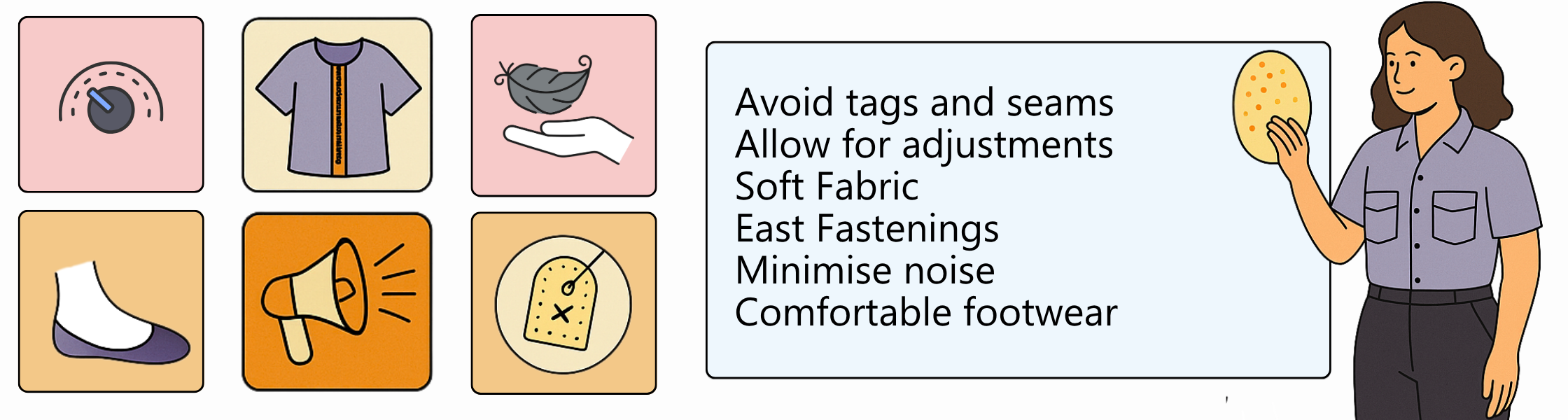
Labels and seams are a common source of discomfort among the neurodivergent community, with many people comparing their effects as akin to being stabbed with a tiny needle. With your own clothes, a simple solution is to cut the label out and avoid clothes with raised inner seams, but this isn’t always possible for work uniforms. To make labels and seams less unbearable for those with hypersensitivity, possible solutions are getting garment care instructions printed directly onto the fabric, or placing them discreetly on the outside of the garment and opting for flat, closed seams.
Laundry and upkeep challenges for neurodivergent individuals
Laundry often comes as a challenge for neurodivergent individuals, and those with ADHD in particular. Difficulties with task switching often make the multi-step process of doing the laundry even more challenging, with wash cycles often getting abandoned mid-way through the process. Clothes that require dry cleaning or ironing involve even more upkeep – adding even more to the already heavy mental load. This will probably be a constant battle that some of your neurodivergent employees have to take home with them, but here are a few things you could do to make it easier:
- Provide clear washing instructions, preferably printed inside the clothes so they don’t get lost.
- Make all items of uniform the same colour, so they can be bunged on the same load without the need for colour separating.
- Choose lightweight, sweat wicking materials that are easier to dry, making the drying part less arduous – particularly on cold or wet days.
- Set a laundry day with reminders if desired.
- Consider providing laundry services. This could be helpful for those who struggle to maintain hygiene and daily tasks. Others may prefer to wash their clothes themselves to maintain routine or because of sensory issues around different scented detergents/fabric softeners. Some people with traits of OCD may need to wash clothes after every wear and perhaps carry a spare outfit if they feel like they need to change during a shift).
Pro tip: Some neurodivergent individuals like to have their clothes labelled in some way with days of the week, as it helps them with structure, routine and decision-making.
Neuroinclusive clothing design
Neurodivergence often comes hand-in-hand with some motor skills challenges. People with dyspraxia in particular can struggle with fiddly buttons, toggles, small zips, and laces. Large zips or even hook-and-loop or magnetic fastenings are a good choice for those with coordination and movement challenges. Many neurodivergent individuals have an aversion to pulling clothing over their heads because of the confined sensation it gives. In this case, front-opening clothing with easy fastenings are your best bet.
Shoes are also a struggle for those with sensory challenges, and the wrong shoe can cause physical discomfort, sensory overload and anxiety. While properly-fitting shoes will likely be a must for most workplaces, it’s worth bearing shoe sensitivity in mind when drafting up uniform policies, and making reasonable adjustments wherever possible for neurodivergent individuals so they can wear shoes that keep them comfortable.
The impact of poorly chosen workplace uniforms
When chosen with all of the workforce in mind, workplace uniforms create team spirit, togetherness, and brand loyalty. But mandatory uniforms that are poorly adapted to neurodiverse needs can lead to sensory issues, discomfort, distraction, and ultimately a loss of productivity in the workplace.
Are you designing a work uniform policy? Let’s discuss how we can align your productivity goals and create a neuroinclusive uniform code that all employees feel comfortable, productive, and proud to wear.